
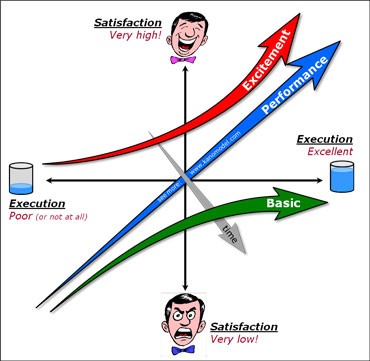
The Kano Model, developed by Professor Noriaki Kano in the 1980s, is a powerful framework for understanding customer preferences and prioritizing product features.
It goes beyond the traditional linear view of customer satisfaction, recognizing that not all features impact users equally.
Origin of the Kano Model
Dr. Noriaki Kano, a Japanese professor of quality management at the Tokyo University of Science, challenged the prevailing assumption that adding more features and improving performance automatically leads to happier customers. His research led to the identification of five distinct categories of product attributes that affect customer satisfaction in varying ways.
Understanding the Kano Model
The Kano Model categorizes features based on their impact relative to the effort invested in developing them. Here are the five feature categories:
- Expected Needs (Must-Be Quality):
- One-Dimensional Quality (Performance Attributes):
- Attractive Quality (Exciters):
- Indifferent Quality:
- Reverse Quality:
Practical Applications of the Kano Model
1. Product Development:
- Use the Kano Model to prioritize features during new product development.
- Understand which features are must-haves, satisfiers, or delighters.
- Build a roadmap that aligns with customer needs and expectations.
2. Market Research:
- Conduct effective and realistic surveys or interviews to collect user feedback.
- Post detailed analysis and focused deliberations internally, prioritize features based on consumer responses.
- Create a doable, practical and all-encompassing roadmap that aims to maximise the degree of customer satisfaction envisaged.
3. Real-World Examples:
Apple’s iPhone Touch Screen Apple’s introduction of the touch screen on the iPhone was an innovative delighter that exceeded customer expectations2.
- The touch screen transformed the smartphone industry and set a new standard.
- The touch screen transformed the smartphone industry and set a new standard.
Other Industries
- Many successful companies across various sectors have used the Kano Model to enhance their product offerings.
- By identifying exciters and must-haves, they have successfully improved customer satisfaction and loyalty.
The Kano Model provides a nuanced understanding of customer preferences. By applying it effectively, businesses can create products that not only meet expectations but also delight users.
However, it’s not just about adding features; it’s about understanding their impact on customer satisfaction.
For more information, check out writings on the original research by Dr. Noriaki Kano.
Also – to explore real-world case studies and success stories associated with this powerful model.
Remember, as you navigate the dynamic landscape of customer satisfaction, the Kano Model can be your compass, guiding you toward creating exceptional products that resonate with your audience.
Further suggested readings
AI tools available in open domain
Disclaimer 1: – The views and opinions included in this article belong entirely to the author and do not in any manner whatsoever, necessarily mirror the views and opinions of the company where he is currently employed.
Disclaimer 2 : The Kano Model is a valuable tool, but its success depends on proper implementation and context. Adaptation to specific business needs is mandatory. The above article is purely for informative purposes.